Best Beehive for Beginners: 4 Hive Types Compared
Best Beehive for Beginners: Langstroth vs. Top-Bar vs. Warré vs. Flow Hive
You decide to keep bees, search for your first hive, and discover four systems all described somewhere as “the best.”
One offers standardized equipment. Another reduces stacked-box lifting. One emphasizes natural comb. Another lets honey drain through specialized frames.
Quick answer: For many first-time beekeepers, a standard Langstroth hive is often the easiest system to learn because compatible equipment, replacement parts, extractors, mentors and educational resources are widely available. That does not make it universally best. Top-bar hives can reduce stacked-box lifting, Warré hives suit a different management approach, and Flow Hives simplify part of honey harvesting rather than normal colony management.
USU describes Langstroth as the most widely used hive type and highlights its interchangeable parts, widespread support and honey-production compatibility.
Four Hive Systems at a Glance
Langstroth Hive
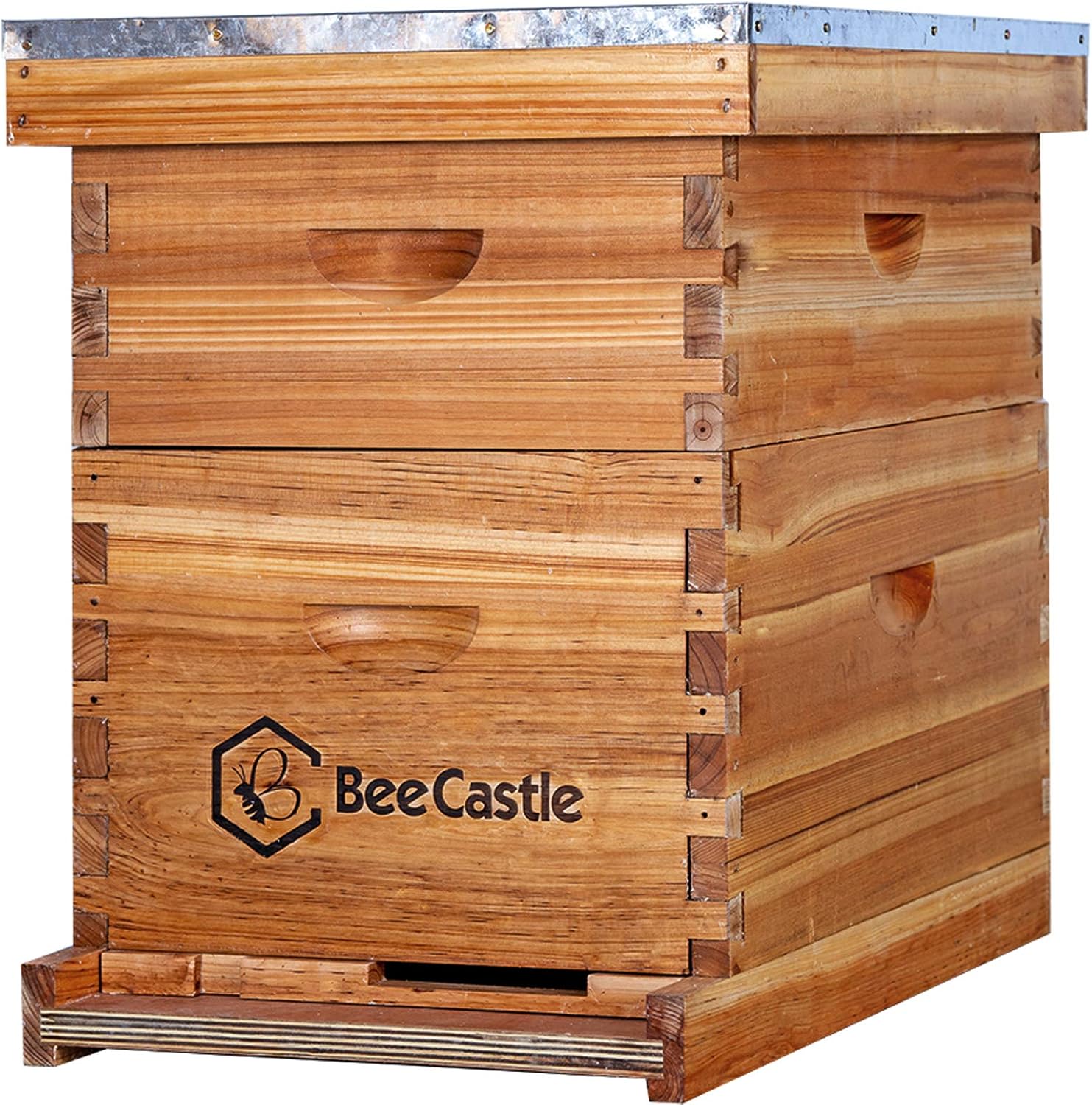
Langstroth hives use vertically stacked boxes with removable frames.
Advantages include:
- standardized equipment
- replacement-part availability
- large mentor ecosystem
- conventional honey extraction
- easy expansion
The main trade-off is lifting.
Full honey boxes can be heavy, and inspections may require removing supers to reach the brood nest.
8-frame vs 10-frame
Eight-frame boxes reduce the number of frames—and usually the potential weight—per box.
Ten-frame gear may be easier to source depending on where you live.
Ask local suppliers and clubs before deciding.
Deep vs medium boxes
Some beekeepers use deep brood boxes with medium honey supers. Others standardize around mediums to simplify interchangeability and reduce individual box weight.
There is no universal configuration for every beekeeper.
Top-Bar Hive
Top-bar hives manage the colony horizontally. Bees build natural comb downward from bars rather than within conventional full frames.
Advantages:
- less stacked-box lifting
- horizontal access
- natural comb
Challenges:
- unsupported comb can break
- less standard equipment
- conventional centrifugal extraction is usually unsuitable
- local mentor support may be limited
Top-bar does not mean maintenance-free. Varroa monitoring, swarm management and health inspections still matter.
Warré Hive
Warré hives use smaller vertically stacked boxes and are associated with a natural-comb, lower-intervention management philosophy.
Potential attractions include smaller boxes and a distinctive management style.
Trade-offs include less convenient inspection in traditional configurations and reduced local equipment/support in many regions.
Check local law
Some jurisdictions require movable or removable comb for disease inspection. Traditional configurations can conflict with those rules.
Do not assume Warré hives are illegal everywhere. Check your apiary authority before buying or building.
Flow Hive
A Flow Hive is fundamentally a managed honey bee colony with specialized honey frames that can drain honey without conventional uncapping and spinning.
That feature simplifies honey removal.
It does not eliminate:
- brood inspections
- Varroa monitoring
- queen assessment
- swarm management
- feeding when needed
- colony-health work
Do not buy it because you think the handle automates beekeeping.
Think About Your Back
Before ordering equipment, imagine lifting it full of honey.
If lifting is a major concern, consider:
- 8-frame Langstroth equipment
- medium boxes
- horizontal top-bar management
- sensible hive-stand height
- cart/wheelbarrow access
Which Hive Is Best for Honey Production?
For conventional extracted honey, Langstroth equipment has a strong practical advantage because it integrates naturally with supers, standardized frames and extractors.
Flow systems offer specialized extraction from their honey frames.
Top-bar and many Warré setups more commonly use crush-and-strain or cut-comb methods.
Whatever system you choose, review When Is Honey Ready to Harvest? before removing a crop.
Local Support Matters
Ask:
- What hive system does my local club use?
- Can I buy compatible frames today if one breaks?
- Can I borrow an extractor?
- Can a mentor help me inspect this exact hive?
- Are nucleus colonies sold on compatible frames?
Standardization becomes valuable when something goes wrong on a weekend.
What Should a Beginner Kit Include?
For a conventional setup, core components usually include:
- bottom board
- brood box(es)
- frames
- foundation if used
- covers
- entrance reducer
- stable stand
You also need a hive tool, smoker and protective gear. For clothing, see Ventilated Bee Suit vs. Cotton Suit vs. Bee Jacket.
Starter-Kit Red Flags
Watch for:
- unknown dimensions
- proprietary parts with poor availability
- weak joints
- warped boxes
- poor lid fit
- incompatible frame sizes
- unclear return policy
- “maintenance-free beekeeping” claims
Used Equipment
Used equipment can save money but may carry disease risk or incompatible dimensions.
Investigate the equipment history before introducing unknown brood comb to your apiary.
Beginner Decision Guide
Choose Langstroth if...
You prioritize standard equipment, mentors, conventional extraction and easy expansion.
Consider Top-Bar if...
You prioritize horizontal management and reduced stacked lifting.
Consider Warré if...
You intentionally want that management philosophy and have verified inspection/legal compatibility.
Consider Flow if...
Specialized honey removal matters to you and you understand that normal colony management remains necessary.
Final Takeaway
There is no universal best hive.
There is a hive that fits your body, goals, local rules, equipment market and mentor network.
For many beginners, Langstroth is the straightforward starting point because an entire support ecosystem already exists around it. Choose an alternative because its trade-offs solve a real problem for you—not because the marketing looks easier.
Equipment Mentioned in this Guide